Blog
-
Even a gentle exercise program could cause lasting harm to patients with ME/CFS or long Covid

Exercise: it’s good for nearly everyone. Photo: Cliff Booth/Pexels. In honor of this year’s ME Awareness day we’re sharing a very simple message: for patients with long Covid or ME/CFS, exercise can be dangerous.
We know, we know: exercise is supposed to be the cure-all, the one piece of advice that can be safely given to any patient. It’s beneficial to the young and to the elderly, to healthy people, to the chronically ill, to cancer patients and to those recovering from injury.
And yet exercise isn’t safe for everyone. You wouldn’t recommend yoga to a person with a concussion, or a spinal injury.
“If exercise is medicine, you should treat it like medicine. You should understand what the contraindications are, who might have adverse effects of the medicine, and how to dose the medicine effectively for each person.” –David Putrino, quoted in National Geographic: For some long COVID patients, exercise is bad medicine
The bodies of people with ME/CFS, and some of those with long Covid, don’t respond to exercise in the usual way. Activities that were once performed with ease become difficult or impossible. Patients often try to ‘push through’ – they try to stick to an exercise program, or they force themselves to continue doing all their usual activities, often with encouragement from doctors or physiotherapists – but the result can be a permanent worsening of illness severity, bringing with it a decreased level of overall function. Exercise can make people with ME/CFS or long Covid more disabled, permanently.
(more…) -
The NHS must provide mandatory training on ME/CFS – our submission to the APPG
The All-Party Parliamentary Group on Myalgic Encephalomyelitis will be meeting later this month, and we’ve submitted a short statement for their consideration, which is also pasted below.
Please urge the NHS to provide mandatory training on ME/CFS to doctors. Most doctors receive no training on ME/CFS, either during their time at medical school or after, and as a result patients wait years for diagnosis and receive outdated, inappropriate and harmful treatments. The consequences are unnecessary suffering, increased disability, and avoidable deaths.
Hospital doctors have no idea how to deal with patients with severe ME/CFS, and therefore fail to provide the appropriate care. Maeve Boothby-O’Neil died of ME/CFS in 2021 after hospital doctors repeatedly refused to provide enteral feeding, a simple, routine procedure that might have saved her life. More recently the case of Alice Barnett was in the news; Barnett’s family had to fight for her to receive needed medical treatment after hospital doctors refused to provide it, in violation of the NICE guidance.
Children and young people face particularly bad treatment as doctors who don’t understand ME/CFS push them into therapies and rehabilitation programs that are harmful for them, and make them sicker.
(more…) -
Integrating ME/CFS into an undergraduate curriculum: experience from a US medical school
In what might be a world first, the Frank H. Netter School of Medicine in the US has fully integrated ME/CFS into its curriculum.

Dr Howard Andrew Selinger, MD. Photo: Quinnipiac University. The training program was developed by Dr Howard Andrew Selinger, a family physician and Chair of Family Medicine at the school. When asked how he became involved with ME/CFS, Selinger replied:
“Well, I have to be honest and say that for the first thirty-five years I knew nothing about it, like most family physicians, I think. That is the norm, unfortunately. I became involved when I was approached by a lovely woman who struggles with it, and is in her eighth decade of life, and we were blessed with an endowment for my chair, and the ask that came with that endowment was to please develop a curriculum so students of medicine can hear about this, understand the fundamentals, and enter their clinical careers so that they can build on that knowledge base.”
(more…) -
Update on our campaign
The ME/CFS Medical Education Campaign started up in December of last year, with the goal of ensuring that all UK doctors and medical students receive high-quality, up-to-date, evidence-based training on ME/CFS.
The problems we face are very familiar to the ME community, but they might be unfamiliar to clinicians and medical educators:
- ME/CFS is a common and very serious condition, yet most doctors know little about it.
- Medical students receive little to no training on ME/CFS, and have little knowledge of the condition.
- People with ME/CFS receive an unacceptably low standard of medical care. Many wait years for diagnosis, and are given inappropriate and harmful medical advice. The NICE guidelines are routinely ignored. Things are even worse for children and young people, and for those with severe ME/CFS.
-
To which area of medicine does ME/CFS belong, and who should teach it?
With the Medical Licensing Assessment coming into effect in 2024-2025, medical schools across the UK will be preparing to teach ME/CFS for the first time, and they will find themselves facing a conundrum: which class or subject area does the condition fit into, and which educators are best-qualified to teach it?

Cropped image from the cover of the General Medical Council‘s MLA content map. ME/CFS is a multisystem illness; research has shown that people with ME/CFS have abnormalities in their nervous, immune, and cardiovascular systems, and at the cellular level there are disturbances to the biochemical pathways which produce ATP.1 Moreover, ME/CFS can be viewed as a post-acute infection syndrome;2 it has historically occurred in outbreaks, and up to 75% of ME/CFS patients report an infectious onset.2 Its etiology is unknown.
All this suggests that ME/CFS could reasonably belong to any number of medical specialties or subject areas including cardiology, immunology, and infectious diseases. However ME/CFS tends to be viewed as an ‘orphan’ disease which has not been claimed by any medical specialty.
In practice, GPs are responsible for diagnosing and managing ME/CFS. Specialist ME/CFS services do exist in some parts of the UK, but (with a few exceptions) they are staffed by occupational therapists or nurses, not by doctors, and are unable to provide medical advice or treatment.
The GMC requires that training on ME/CFS be included in post-graduate programs on: Paediatrics Specialty Syllabus, Paediatric Rheumatology, Immunology Curriculum, Infectious Diseases curriculum, Tropical Medicine curriculum, Liaison Psychiatry, and Curriculum for Acute Internal Medicine.3
When it comes to undergraduate training, it seems that medical schools will have to decide for themselves which classes ME/CFS should be included in and who should teach it, perhaps in consultation with the Medical Schools’ Council.
References
1. Marshall-Gradisnik S, Eaton-Fitch N. Understanding myalgic encephalomyelitis. Science. 2022 Sep 9;377(6611):1150-1151. doi: 10.1126/science.abo1261. Epub 2022 Sep 8. PMID: 36074854. https://www.science.org/doi/10.1126/science.abo1261
2. Choutka, J., Jansari, V., Hornig, M. et al. Unexplained post-acute infection syndromes. Nat Med 28, 911–923 (2022). doi:10.1038/s41591-022-01810-6.
https://www.nature.com/articles/s41591-022-01810-63. Rosie King, personal communication.
-
Website redesign
We’ve had a bit of a redesign – hopefully the new website will be easier to navigate, but please let us know if anything has disappeared or doesn’t work.
-
Letter to the Medical Schools’ Council on teaching ME/CFS to undergraduates
The Medical Schools’ Council coordinates medical schools’ teaching across the UK. We reached out to them to ask them to speak to medical schools about providing high-quality teaching on ME/CFS, to give a bit of background information about the condition, and to recommend some learning resources. The letter is posted below.
Recommended ME/CFS resources for medical educators (pdf)
Good morning, I’m writing to bring your attention to some important and difficult issues regarding undergraduate medical education on myalgic encephalomyelitis/chronic fatigue syndrome (ME/CFS), and to share some resources for medical educators.
The scientific understanding of ME/CFS has moved forward by leaps and bounds in recent years, and standards of clinical practice have changed dramatically. The 2021 NICE guidance on ME/CFS is a radical departure from the 2007 guidance which preceded it.
(more…) -
#DontLetMEDie protest: ME/CFS patients demand medical treatment
Most medical professionals have no idea that people with ME/CFS are so angry about the standard of medical treatment that they receive – or don’t receive – that they hold protests about it.
On 8 March the campaigning group Chronic Collaboration held a protest in front of parliament, brandishing banners and placards with slogans such as “Don’t Let ME Die”. ME stands for myalgic encephalomyelitis, the disease that is also known as myalgic encephalomyelitis/chronic fatigue syndrome (ME/CFS).
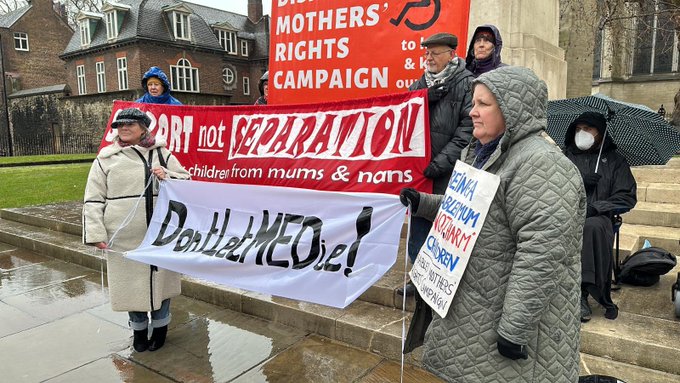
A group of ME campaigners held a protest outside parliament on 8 March, 2023. Another slogan was “Support not Separation”, a reference to the practice of misdiagnosing children who in fact have ME/CFS with fabricated or induced illness (FII), which results in the children being taken into care.
The protesters’ demands included a review of how (or if) the NICE guidelines on ME/CFS are being implemented by NHS England, Health Education England, and the GMC.
(more…) -
Doctors’ lack of training leads to malnutrition danger for patients with severe ME/CFS
Update: as of March 1, Alice Barnett has had a feeding tube inserted and is receiving nutrition.
Some patients with very severe ME will require tube feeding, either enterally or parenterally. There can often be a significant delay in implementing this, due to professional opinion, allowing the patient to become severely malnourished. Healthcare professionals may fail to recognize that the problems are a direct consequence of very severe ME, preferring to postulate psychological theories rather than addressing the primary clinical need.
Baxter H, Speight N, Weir W. Life-Threatening Malnutrition in Very Severe ME/CFS.Studies show that, shockingly, most UK doctors have no training at all on ME/CFS. This can create a dangerous situation for patients, particularly those with the most severe form of the illness. People with severe ME/CFS sometimes become unable to swallow food, which puts them at risk of life-threatening malnutrition. They go hospital, with relatives warning that the patient hasn’t eaten properly in days or weeks – but tests show nothing wrong, and doctors don’t believe that the patient is as sick as the family says they are. Tube feeding is delayed or refused altogether, putting the patient in deadly danger.
(more…) -
Doctors’ reluctance to diagnose ME/CFS has horrific consequences for children
Dr Nigel Speight is a pediatrician, now semi-retired, with a special interest in myalgic encephalomyelitis (ME). The following is an excerpt from an interview carried out by Rob Wijbenga, chairman of the Dutch ME/CFS Association. In it, Dr Speight describes how doctors’ inability to confidently recognize and diagnose ME/CFS can result in an alternate ‘explanation’ – that the child’s inability to carry out normal activities is the parents’ fault, with the consequences that children are forced into inappropriate therapies which harm them, and are even taken from their families. While this interview is ten years old, there is no reason to think this is not still happening now in the UK. The NICE guidelines were updated in 2021, but clinicians have not been informed of the new clinical standards. Mandatory training on ME/CFS for all UK doctors is urgently needed to prevent medical abuses like the ones that Dr Speight describes below.

A lot of it comes from a simple failure of doctors to protect patients by diagnosing them with ME/CFS.
This is a very painful area, it’s one of the most unpleasant things I’ve witnessed in my entire medical career. It’s something that I’ve seen all over the British Isles, I’ve had cases scattered throughout the map of Great Britain and they all seem to have similar causes, and a lot of it comes from a simple failure of doctors to protect patients by diagnosing them with ME/CFS, which then leaves them at risk of being persecuted for alternative explanations. I’ve had over 30 cases which have all resulted in child protection proceedings with case conferences being held, and a threat of removal. Fortunately most of them, we have managed to avert by early intervention and giving second opinions, but [in] quite a few [there] has actually been a real threat of removal, and one or two children have actually spent time away from their families, against their will, because of court proceedings.
There’s one [case] in the Midlands, we’ll call her Tiffany, it’s not her real name, for confidentiality, a lovely thirteen-year-old girl, lively, talented, musical, and she was in perfect health until she was struck down by quite acute onset ME at the age of thirteen, and she was so ill that her mother had to turn to hospital doctors for admission to hospital. And she did this openly and trustingly. And once in hospital she was under a pediatrician who believed in ME, and everything seemed alright.
(more…)
 ME/CFS Medical Education Campaign