

In honor of this year’s ME Awareness day we’re sharing a very simple message: for patients with long Covid or ME/CFS, exercise can be dangerous.
We know, we know: exercise is supposed to be the cure-all, the one piece of advice that can be safely given to any patient. It’s beneficial to the young and to the elderly, to healthy people, to the chronically ill, to cancer patients and to those recovering from injury.
And yet exercise isn’t safe for everyone. You wouldn’t recommend yoga to a person with a concussion, or a spinal injury.
“If exercise is medicine, you should treat it like medicine. You should understand what the contraindications are, who might have adverse effects of the medicine, and how to dose the medicine effectively for each person.” –David Putrino, quoted in National Geographic: For some long COVID patients, exercise is bad medicine
The bodies of people with ME/CFS, and some of those with long Covid, don’t respond to exercise in the usual way. Activities that were once performed with ease become difficult or impossible. Patients often try to ‘push through’ – they try to stick to an exercise program, or they force themselves to continue doing all their usual activities, often with encouragement from doctors or physiotherapists – but the result can be a permanent worsening of illness severity, bringing with it a decreased level of overall function. Exercise can make people with ME/CFS or long Covid more disabled, permanently.
There is some nuance here. Exercise isn’t always harmful, and even when it is, that harm is usually not permanent. It is possible for some people with ME/CFS or long Covid to safely perform a carefully tailored exercise program and derive benefit from it. And only about 50% of those with long Covid suffer from PESE (post-exertional symptom exacerbation) – for the rest, exercise is likely to be beneficial.
Screening for PESE, and helping those who suffer from it find a safe level of activity, is complicated. Ideally, patients should be guided by an expert. For those clinicians who don’t have time to become experts, the message is simple: exercise could harm your patients with long Covid or ME/CFS. Especially for patients who are newly ill, or who are newly suspected of having these conditions, the safest advice is: rest as much as possible, and don’t do any exercise at all.
Graded Exercise Therapy (GET)
Graded Exercise Therapy, or GET, just means any exercise program whose intensity increases over time. For years GET was recommended to people with ME/CFS, and more recently exercise programs which fit the definition of GET, even if they aren’t called that, are recommended to people with long Covid.
GET should never be recommended to patients with ME/CFS, and should not be recommended to patients with long Covid unless PESE has been definitively ruled out.
Many of our members were made more ill by undertaking GET. – 25% ME Group, evidence submitted to the National Institute of Health and Care Excellence (NICE)
Do not offer people with ME/CFS any therapy based on physical activity or exercise as a cure for ME/CFS… for example, graded exercise therapy. – National Institute of Health and Care Excellence (NICE) NG206 1.11.14
Post-exertional symptom exacerbation (PESE)
When we talk about exercise or other activity causing harm to people with ME/CFS or long Covid, we’re talking about post-exertional symptom exacerbation (PESE), also known as post-exertional malaise (PEM) or post-exertional neuro-immune exhaustion (PENE).
PESE has nothing to do with ordinary tiredness, or with the stiffness and sore muscles that anyone might experience after exercise. PESE is an increase in illness severity following exertion, often with a delay of 12-48 hours, and lasting days, weeks, or months, and sometimes resulting in permanent relapse.
It’s not just exercise.
PESE can be provoked by any type of exertion, physical, cognitive, or emotional. Many people with ME/CFS report that they pushed themselves to continue working, but this overexertion led to a further deterioration.
However in this article we’re focusing on exercise, if only because it’s probably the most dangerous type of activity, and perhaps also the easiest to avoid. After all, it’s easier to stop going to the gym than it is to stop going to work or looking after the kids.
But what if the exercise is extremely gentle? And what if it increases only very gradually? That would be fine, no?
For a person who doesn’t experience PESE, yes, that would most likely be fine.
But for people with ME/CFS, and people with long Covid who experience PESE, the amount of activity that can be tolerated varies wildly from person to person. Someone with mild illness might tolerate a fifteen minute walk, while a severely ill patient might trigger PESE simply by sitting up in bed. There is no one exercise program that will work for all patients, or even most patients, and some won’t be able to safely do any exercise at all.
As for increasing exercise intensity: we are used to the idea that if a person exercises regularly, they will be able to do a little bit more with each passing week. That’s how human bodies work – usually. But people with ME/CFS and long Covid have a level of exertion that they cannot push beyond without making themselves sicker. They can’t build up their fitness the way healthy people can. They do become deconditioned, but it’s important to remember that deconditioning is a result of the illness, not a cause of it.
Pacing
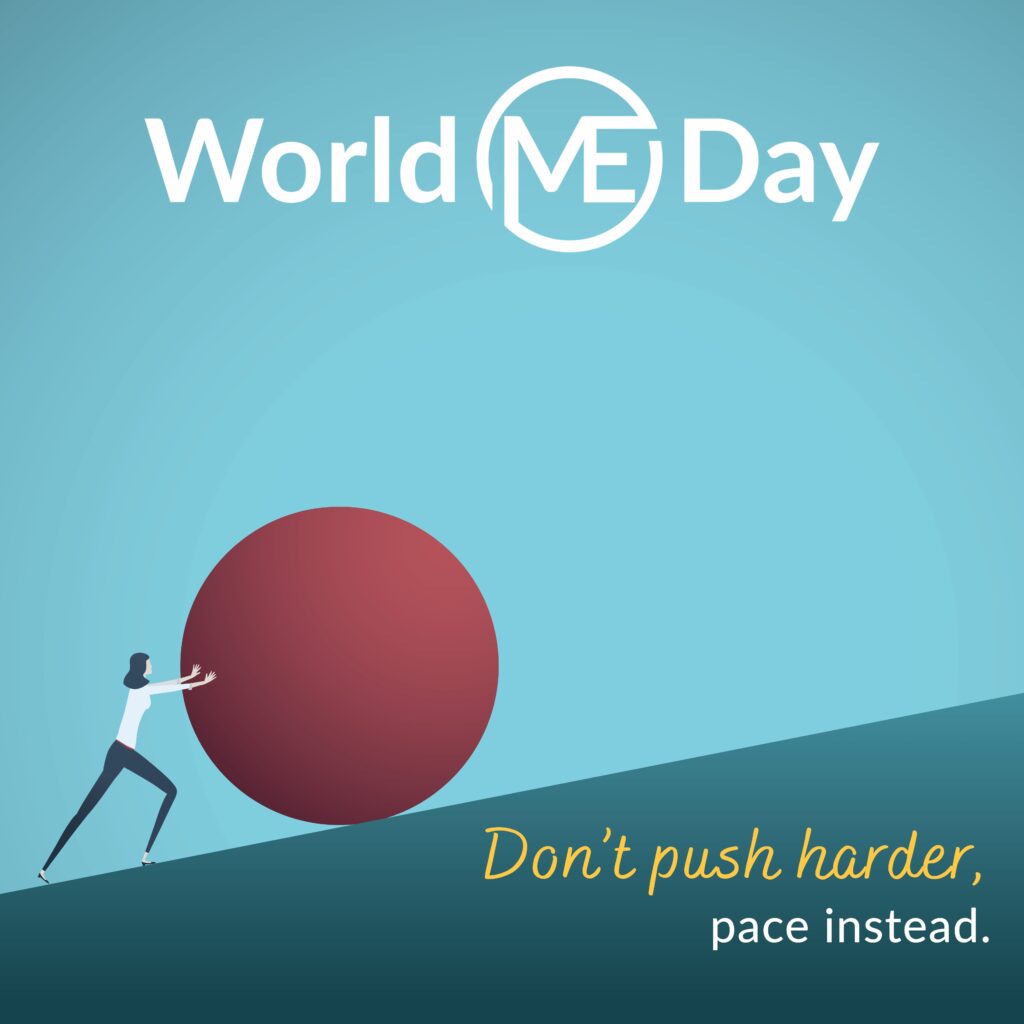
Pacing is the gold standard of illness management for ME/CFS, and now long Covid. It’s very simple in principle: reduce activity and add in rest periods until the patient no longer experiences PESE.
In practice this can be incredibly difficult for several reasons: because people can’t always predict in advance how much activity they will be able get away with, because the ‘safe’ level of activity can change from day to day, and because cutting out daily activities isn’t always possible. People almost always over-exert, especially those who are new to the illness.
One of the best options to minimize or prevent PEM is to help patients learn to keep all energy expenditures, physical, cognitive and emotional, within limits that can be tolerated by planning when and how to use their limited energy. This approach is known as pacing. Minimizing PEM can lead to stabilization or improvements in pain, sleep, fatigue, cognition, and other symptoms. – CDC: Managing Post-Exertional Malaise (PEM) in ME/CFS
Further reading
Pacing:
- ME Association: Assessing PEM (Post-exertional malaise) 14 pages, 2019.
- CDC: Managing post-exertional malaise (PEM) in ME/CFS 1 page.
- MEAction: Clinicians’ pacing and management guide for ME/CFS and long Covid 8 pages, 2023.
- MEAction: Clinicians’ pacing and management guide for pediatric ME/CFS and long Covid 5 pages, 2022.
- Action for ME: Pacing for people with ME 60 pages, 2020.
- World Physiotherapy briefing paper: Safe rehabilitation approaches for people living with long Covid: physical activity and exercise 30 pages.
- Dialogues ME/CFS: Activity management – pacing 15 minute video
- J Med Virol: Effect of using a structured pacing protocol on post-exertional symptom exacerbation and health status in a longitudinal cohort with the post-COVID-19 syndrome 10 pages, 2023.
Guides to ME/CFS for clinicians:
- ME/CFS: Essentials of Diagnosis and Management; Mayo Clinic Proceedings Consensus Recommendations.
- ME/CFS Information for Healthcare Providers; Center for Disease Control; US.
- What Primary Care Practitioners Need to Know about the New NICE Guideline for Myalgic Encephalomyelitis/Chronic Fatigue Syndrome in Adults. Kingdon, C.; Lowe, A.; Shepherd, C.; Nacul, L. Healthcare 2022, 10, 2438. doi.org/10.3390/healthcare10122438.
- (EUROMENE): Expert Consensus on the Diagnosis, Service Provision, and Care of People with ME/CFS in Europe.
Exercise can be dangerous to patients with ME/CFS and long Covid:
- ME and PEM 3 minute video
- BMJ: NICE cautions against using graded exercise therapy for patients recovering from covid-19 2020.
- Neuro Endocrinol Lett: A review on cognitive behavorial therapy (CBT) and graded exercise therapy (GET) in myalgic encephalomyelitis (ME) / chronic fatigue syndrome (CFS): CBT/GET is not only ineffective and not evidence-based, but also potentially harmful for many patients with ME/CFS 2009.
- Diagnostics: Assessment of Post-Exertional Malaise (PEM) in Patients with Myalgic Encephalomyelitis (ME) and Chronic Fatigue Syndrome (CFS): A Patient-Driven Survey 2019.
Pathophysiology underlying PESE/PEM and exercise intolerance in ME/CFS and long Covid:
- Science: Understanding myalgic encephalomyelitis: Myalgic encephalomyelitis and Long Covid have overlapping presentations 2022.
- Chest: Persistent Exertional Intolerance After COVID-19 Insights From Invasive Cardiopulmonary Exercise Testing 2022.
- Pulmonary Circulation: Proteomic profiling demonstrates inflammatory and endotheliopathy signatures associated with impaired cardiopulmonary exercise hemodynamic profile in Post Acute Sequelae of SARS‐CoV‐2 infection (PASC) syndrome 2023.
- Am J Respir Crit Care Med.: Decreased Fatty Acid Oxidation and Altered Lactate Production during Exercise in Patients with Post-acute COVID-19 Syndrome 2022.
- Med Clin (Barc): Cardiopulmonary Exercise Testing in Patients with Post-COVID-19 Syndrome 2022.
- Chest: Insights From Invasive Cardiopulmonary Exercise Testing of Patients With Myalgic Encephalomyelitis/Chronic Fatigue Syndrome 2021.

 ME/CFS Medical Education Campaign
1 thought on “Even a gentle exercise program could cause lasting harm to patients with ME/CFS or long Covid”